 GRXEL
GRXEL
The quickest way to make a traffic-control quote confusing is to ask for “some barricades.” A buyer may mean three-rail road-closure units. A crew may be picturing drums. Someone else may use barrier for anything orange. The distinction matters before the truck is loaded.
This guide uses the FHWA Manual on Uniform Traffic Control Devices (MUTCD), 11th Edition with Revision 1 as its federal baseline. It is a purchasing and vocabulary guide, not a temporary traffic control (TTC) plan, an engineering design or approval for field use. Build the order from the governing agency's adopted requirements, applicable state supplement, contract documents and approved TTC plan. A knowledgeable traffic-control professional still has to evaluate the location.
The labels in the MUTCD matter. A Standard is a required or specifically prohibitive practice and typically uses shall. Guidance is recommended practice for typical situations and typically uses should, with a documented engineering judgment or study able to support a different choice. The comparisons below identify that distinction where it changes a purchasing decision; the current complete MUTCD PDF remains the controlling federal source.
Start with the job the device has to do
| Device | What identifies it | Where it commonly fits | What it does not establish by itself |
|---|---|---|---|
| Type I barricade | One horizontal rail | One federal Option for conventional roads or urban streets; Type I and II are described for locations where flow continues | A full road closure or positive protection |
| Type II barricade | Two horizontal rails | Federal Guidance recommends Type 2 or 3 on freeways, expressways and other high-speed roadways | Approval for a particular high-speed setup |
| Type III barricade | Three horizontal rails, with a longer minimum rail than Type I or II | Federal Guidance recommends Type 3 for a road closure or partial closure | Impact protection for workers or a hazard |
| Cone | Predominantly orange, portable and readily displaced | Short-duration delineation, lane division and channelizing where the plan permits | The conspicuity of a drum or the function of a barrier |
| Drum | Large, lightweight, deformable orange-and-white channelizer | Prolonged placement or locations needing greater target value | A crashworthy protective wall |
| Direction Indicator Barricade | A W1-6 one-direction arrow sign above a striped rail | Tapers, transitions and other locations needing unmistakable directional guidance | A general-purpose substitute for every barricade |
| Longitudinal channelizing device | Lightweight, deformable units connected into a continuous line | Continuous pedestrian or vehicle guidance where approved | Positive protection or hazard shielding |
| Temporary traffic barrier | A barrier system selected and installed for a protective function | Separating traffic from a work space or hazard when the project design calls for it | A device to use solely for ordinary channelization |
For Type I, Type II and Type III, count the rails first
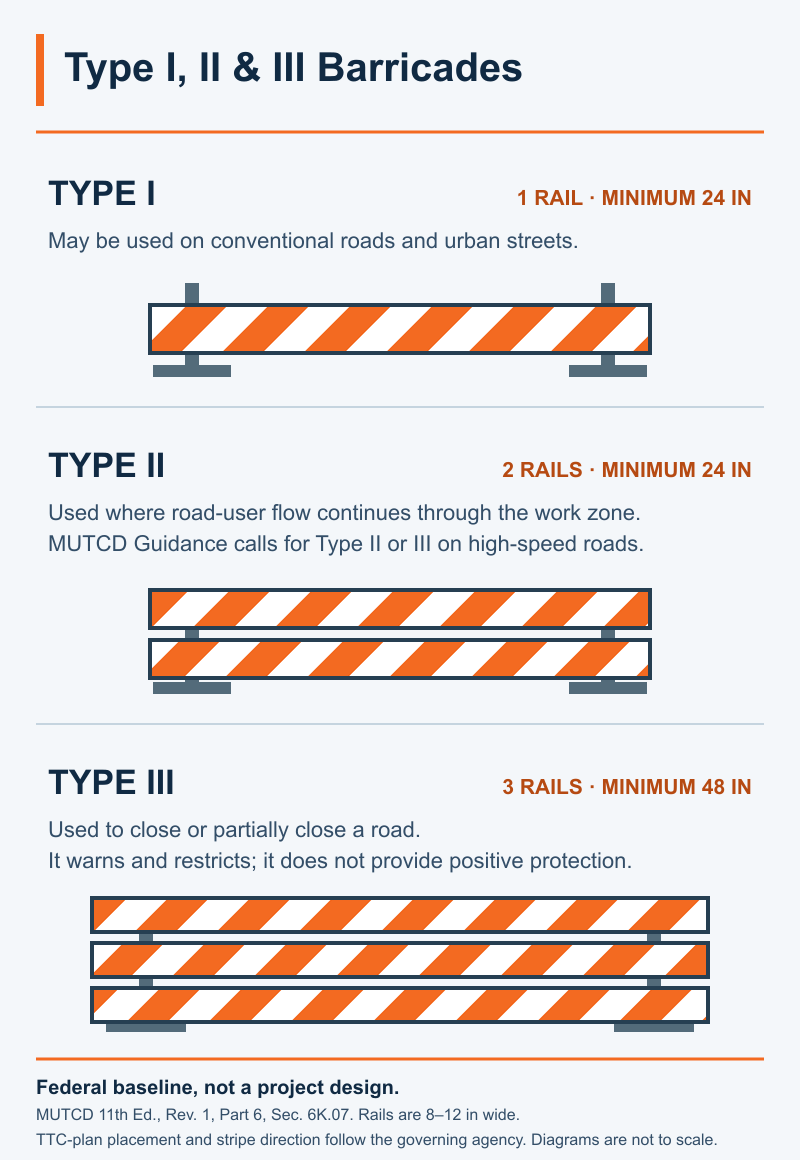
The current MUTCD calls them Type 1, Type 2 and Type 3 barricades. Supplier catalogs more often use Type I, Type II and Type III, so those are the labels used here. The distinction is pleasantly literal: one rail, two rails or three. It is not a good-better-best scale. A Type III belongs on a different kind of job from a Type I.
The Standard provisions in MUTCD Section 6K.07 set a 24-inch minimum rail length for Type 1 and Type 2 and a 48-inch minimum for Type 3. Each rail is 8 to 12 inches wide. The same Standard requires alternating orange and white retroreflective stripes sloping downward at 45 degrees in the direction road users are to pass, subject to the stripe-width Option for rails shorter than 36 inches. These are federal device-design requirements, not a complete project specification.
Stripe direction across a full closure appears separately as Guidance. The stripes should point toward the required turn; if turns are available in both directions, they should slope down from the center in both directions; if no turn is intended, they should slope toward the center. The TTC plan needs to show which condition applies.
The MUTCD's Support text describes Type 1 or Type 2 barricades as intended for situations where road-user flow continues through the TTC zone, and an Option allows Type 1 on conventional roads or urban streets. Its Guidance recommends Type 2 or Type 3 on freeways, expressways and other high-speed roadways, and recommends Type 3 to close or partially close a road. Those recommendations help define a shortlist; the project documents make the actual selection.
Road speed does not settle the purchase on its own. Duration, darkness, available width, wind, the people moving through the site, accessories, crashworthiness records and agency details can all change the request. A Type II barricade product example is useful beside a four-foot Type III barricade kit or six-foot Type III kit because the differences become concrete. The product page still starts the submittal review; it does not prove that the device fits the job.
Cones are quick to deploy—and easy to underspecify
Cones are portable channelizing devices when the TTC plan calls for them. The Standard in Section 6K.03 sets an 18-inch minimum for daytime use on low-speed roadways. It raises the minimum to 28 inches on freeways and other high-speed highways, at night on all highways, or when more conspicuous guidance is needed.
Night use also brings Standard retroreflective or lighting requirements. For a 28- to 36-inch cone, the MUTCD specifies a 6-inch white band near the top and a 4-inch white band below it. Cones taller than 36 inches use the alternating orange-and-white stripe pattern set out in the section. Put the applicable configuration from the plan and agency detail on the purchase order; “28-inch orange cone” leaves the night-work requirement unresolved.
Cones can be displaced by wind or moving traffic. MUTCD Guidance calls for steps to minimize that risk and for ballast to be kept to the minimum amount needed. Ask how the base, body and reflective collars are supplied and replaced. A channelizer cone example can frame those questions without becoming a universal answer.
Drums make more sense when the setup will stay put
Traffic drums are not barrels pulled from a warehouse. The Section 6K.06 Standard requires lightweight, deformable devices at least 36 inches high and at least 18 inches wide, with the specified alternating orange-and-white retroreflective horizontal stripes. The Standard prohibits metal drums.
The MUTCD notes the good target value of drums and their common use in layouts that remain in place for a while. They channelize traffic and mark a location; they do not provide positive protection. Its Guidance cautions against adding enough weight to create a strike hazard, and a separate Standard says ballast shall not be placed on top. A traffic drum example shows the offered configuration. Check the project requirements separately before it goes on the order.
Directional devices are more than striped boards
A Direction Indicator Barricade is its own MUTCD device. Its Standard design places a W1-6 One-Direction Large Arrow sign above a diagonally striped horizontal rail. An Option permits the device in tapers, transitions and other locations needing specific directional guidance; Guidance recommends a series when it is used to direct drivers through a transition. It is not simply a Type III barricade with an arrow attached. Put the arrow direction and device series from the approved drawing into the staging list.
Vertical panels are another space-conscious channelizing option recognized in Part 6. They can divide lanes or replace a barricade where lateral room is limited. Neither device removes the need to follow the TTC drawing, sign sequence and spacing approved for the location.
A barricade is not a traffic barrier
This language causes expensive mistakes. A barricade warns, closes, restricts or delineates. A temporary traffic barrier is selected and installed to help protect the work space or an exposed hazard. FHWA's barrier terminology FAQ describes a barrier as providing positive protection and a barricade as offering little or no resistance when struck.
Part 6 adds an important procurement boundary. A Standard says temporary traffic barriers shall not be used solely to channelize road users; they also protect the work space. When a barrier serves a channelizing role, the Standard calls for the specified delineation, markings or channelizing devices. Connected longitudinal channelizing devices may make a continuous line, but MUTCD Guidance says they should not be used to shield obstacles or provide positive protection because they have not met the crashworthiness requirements for temporary traffic barriers.
If a request mixes the two words, stop and clarify the protective function before pricing. The traffic barricades and barriers buyer's guide is a useful next read, and the broader traffic barricades and barriers category shows why a generic line item is not enough.
How the choice changes from one site to the next
For a daytime utility stop on a low-speed street, cones or a Type I barricade may make the shortlist while traffic continues through the zone. Before ordering the smallest device, check the work duration, the chance that the job runs into darkness, pedestrian routing and the agency's minimum device height. The approved setup governs.
An overnight lane closure on a higher-speed road is a different order. Nighttime cone height and band requirements change, and the plan may call for the greater target value of drums. MUTCD Guidance recommends Type 2 or Type 3 barricades for higher-speed facilities. Set quantities only after the plan and applicable state requirements are in hand.
For a full local-road closure, federal Guidance recommends Type 3 barricades. That one sentence is not a closure layout. Stripe direction, signs, authorized access, any specified warning lights, visibility and placement remain plan decisions. If the closure shifts people on foot, the accessible route belongs in the plan too. Protection from a drop-off or another hazard is a barrier-design question, not something a Type III purchase resolves.
A taper may use cones or drums to make the channelizing line. Direction Indicator Barricades can reinforce the required direction through a transition when the plan specifies them. In either case, device spacing comes from the plan. An online product photo cannot supply it.
Pedestrian routes need particular care. An orange rail does not create an accessible path. Section 6C.01 requires knowledgeable people to apply the Part 6 pedestrian and worker safety provisions after appropriate evaluation and engineering judgment. Other Standard provisions require adequate access when a TTC zone affects pedestrian movement, and require disrupted, closed or relocated facilities to remain detectable with accessibility features consistent with the existing facility. Because the usable-width, surface, edging and protrusion provisions mix Standards and Guidance, the approved pedestrian plan should state the geometry and devices.
Write the job into the RFQ
The supplier should not have to guess what the site needs. Put the items to be verified directly in the request:
- Governing agency, project standard details and the relevant TTC plan sheet.
- Road class, posted or operating speed information supplied by the designer, and daytime/nighttime use.
- Device class, required dimensions, rail count and quantity.
- Retroreflective sheeting type, color and stripe or collar configuration from the project documents.
- Base, feet or ballast arrangement, including storage and transport constraints.
- Required crashworthiness documentation and the agency's acceptance criteria.
- Sign, warning-light or accessory mounting requirements, without assuming every attachment is approved.
- Pedestrian-route requirements and usable clearance.
- Deployment duration, inspection routine and replacement-stock needs.
- Packaging, pallet quantities, delivery sequence and field-replaceable components.
Then ask for a submittal that names the exact configuration being offered. GRXEL can match available products to a defined request; use the contact page to request a project-specific quote instead of letting a category name stand in for design approval.
Before the order leaves the desk
What separates Type I, Type II and Type III? First, the rail count: one, two or three. MUTCD Support text describes Type 1 and Type 2 at locations where flow continues through the TTC zone, while its Guidance recommends Type 3 for closures or partial closures. Road type, speed, duration, agency requirements and the approved plan still decide the selection.
Can cones replace barricades? They can provide channelization when the plan uses them, but they are not automatic substitutes. Height, nighttime bands, target value, stability and the device's purpose all have to match the plan and agency standard.
Does a Type III provide positive protection? No. It warns or closes. If workers or a hazard need shielding, the design may require a properly selected and installed temporary traffic barrier.
How far apart should the devices be? There is no single purchasing number. Section 6K.01 gives Guidance, rather than a universal Standard, for channelizing-device spacing. Use the approved plan and the governing state or local requirements before calculating quantities.
Finally, do not let a product labeled “MUTCD” end the review. That label cannot establish suitability for a particular road, plan or agency. Dimensions, markings, sheeting, crashworthiness documentation, accessories and acceptance of the exact configuration still need to be checked.